Berberine and Metabolic Regulation — What the Science Actually Says
Blood sugar control is rarely about willpower.
It is about signaling.
Inside your cells, energy balance is regulated by a network of molecular pathways. When those pathways become inefficient—due to diet, stress, sleep disruption, or aging—glucose handling becomes less stable. Insulin resistance may increase. Lipid profiles may drift. Energy fluctuations become noticeable.
This is where berberine enters the conversation—not as a miracle, but as a compound with measurable biochemical activity.
What Is Berberine?
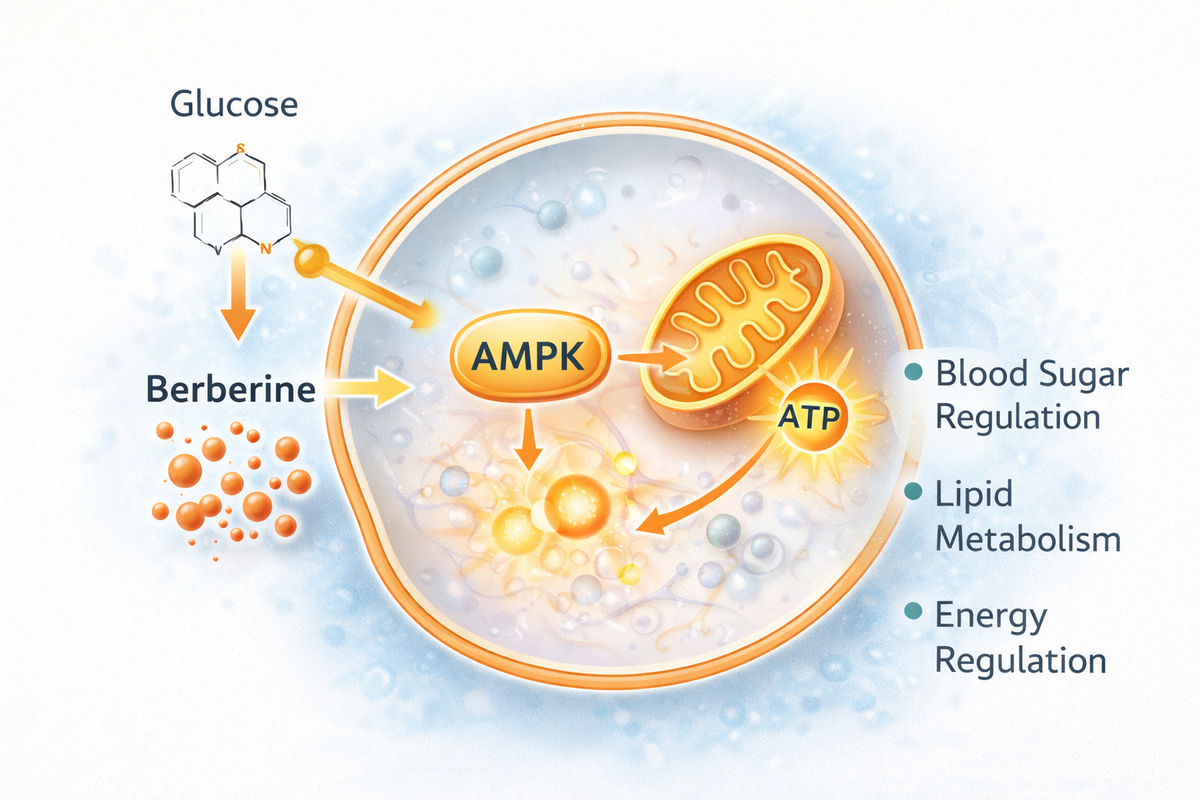
Berberine is a plant-derived alkaloid found in species such as Berberis aristata. Traditionally used in herbal systems, it has gained modern attention because of its interaction with metabolic pathways, particularly AMPK.
AMPK (adenosine monophosphate-activated protein kinase) is often described as the cell’s “energy sensor.” When activated, AMPK encourages:
- Improved glucose uptake
- Increased insulin sensitivity
- Reduced hepatic glucose production
- Enhanced fatty acid oxidation
In simplified terms, AMPK activation shifts the body toward improved metabolic efficiency.
Berberine has been shown in multiple studies to activate this pathway.
That mechanism—not hype—is why it continues to be researched.
Blood Sugar Regulation: What Studies Suggest
Research has explored berberine’s potential impact on:
- Fasting blood glucose
- Postprandial glucose
- HbA1c levels
- Lipid markers
Some clinical comparisons have even examined berberine alongside common glucose-lowering medications, noting overlapping mechanisms through AMPK and insulin sensitivity pathways.
However, it is important to maintain scientific clarity:
Berberine is not a replacement for medical therapy.
It is not a cure.
It is not a shortcut.
Its role is best understood as supportive within a broader metabolic framework that includes nutrition, movement, sleep, and physician guidance.
Cholesterol and Lipid Metabolism
Beyond glucose regulation, berberine appears to influence lipid metabolism.
Mechanisms observed in research include:
- Upregulation of LDL receptor expression
- Reduced cholesterol synthesis in the liver
- Modulation of gut microbiota affecting lipid metabolism
These pathways suggest why some individuals exploring metabolic support look toward standardized formulations such as a 1000mg berberine capsule designed for metabolic balance as part of a structured routine.
Again, the interest is mechanistic—not cosmetic.
The Gut Connection
Emerging research highlights berberine’s interaction with gut microbiota.
The microbiome influences:
- Insulin sensitivity
- Short-chain fatty acid production
- Inflammatory signaling
- Lipid regulation
Berberine’s partial antimicrobial properties may shift microbial composition in ways that indirectly influence metabolic markers.
This gut-mediated effect is still being actively studied, but it expands the discussion beyond “blood sugar supplement” into systems biology.
Metabolism is never one pathway. It is a network.
Dosage Considerations and Absorption
One complexity with berberine is bioavailability. It is not absorbed efficiently in large single doses.
Research protocols often divide doses (e.g., multiple daily administrations) to maintain plasma levels.
Higher-dose formulations—such as standardized berberine 1000mg capsules commonly used in metabolic research contexts—are typically structured for daily intake patterns rather than single megadoses.
Consistency matters more than intensity.
Who Should Be Cautious?
Because berberine influences glucose metabolism, individuals who:
- Are on glucose-lowering medications
- Use insulin
- Have hypotension
- Are pregnant or breastfeeding
should consult healthcare professionals before use.
It may also interact with cytochrome P450 enzymes, meaning drug metabolism could theoretically be affected.
This is not fear-based messaging. It is pharmacological reality.
The Bigger Picture: Why Lifestyle Still Wins
No compound overrides biology.
If sleep is fragmented, diet is highly processed, movement is minimal, and stress is chronic, metabolic signaling will remain dysregulated.
Berberine may assist signaling.
It does not replace structural habits.
The most effective metabolic improvements typically occur when:
- Protein intake supports muscle mass
- Resistance training improves insulin sensitivity
- Circadian rhythm is stabilized
- Refined carbohydrate intake is moderated
Supplements operate within this framework—not outside it.
Why Google-Friendly Content Avoids Exaggeration
Search algorithms increasingly prioritize:
- Mechanism-based explanations
- Balanced risk disclosure
- Absence of exaggerated claims
- Clear differentiation between support and treatment
The goal is informational integrity.
When berberine is discussed as a metabolic pathway modulator—rather than a miracle weight-loss pill—the conversation becomes scientifically coherent.
That coherence is what tends to sustain long-term visibility.
Final Perspective
Berberine is interesting because it interfaces with energy regulation at the cellular level.
It interacts with AMPK.
It influences lipid pathways.
It may alter gut-mediated metabolic signaling.
But it remains a support tool.
Metabolism is a systems issue, not a single-pill solution.
If someone chooses to explore a structured formulation such as a research-backed 1000mg berberine supplement commonly used for metabolic support, it should sit within a comprehensive plan—not substitute for one.
Biology rewards consistency.
Not intensity.