Kojic Acid and Niacinamide for Dark Spots — A Mechanism-Based Approach to Hyperpigmentation
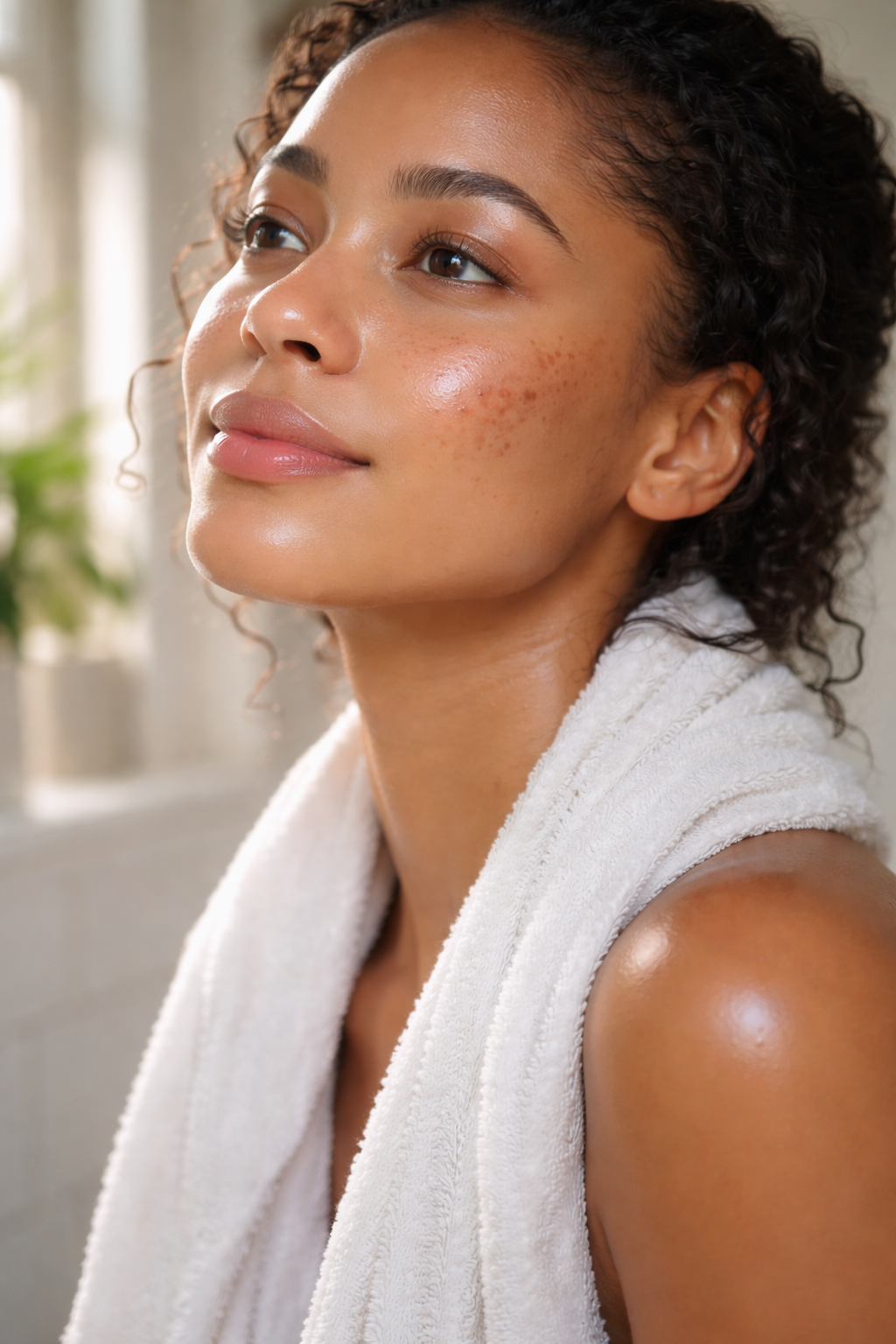
Dark spots rarely appear without cause.
They follow inflammation.
They follow sun exposure.
They follow barrier disruption.
What people casually call “discoloration” usually falls into a few biological categories: post-inflammatory hyperpigmentation (PIH), melasma, or uneven melanin distribution after repeated irritation. These are not simply “surface stains.” They’re regulated responses—melanocytes reacting to signals from the environment and from within the skin itself.
Once you treat dark spots as biology instead of a cosmetic flaw, the strategy becomes clearer: reduce the signals that trigger pigment production, prevent pigment from being transferred upward, and avoid anything that keeps inflammation alive.
That’s the scientific core.
Why Hyperpigmentation Persists
Melanin is produced in melanocytes and then distributed to surrounding keratinocytes (the main cells in the outer skin layer). That distribution is what makes pigment visible at the surface.
Several triggers keep the cycle going:
- UV exposure (even short daily exposure can sustain pigment signaling)
- Inflammation from acne, eczema, friction, over-exfoliation, or irritation
- Barrier disruption that increases inflammatory mediators
- Heat and hormonal factors (especially relevant for melasma)
A common mistake is trying to “scrub away” pigment aggressively. That tends to backfire because inflammation is a melanin amplifier. More irritation → more cytokines → more melanocyte stimulation → more pigment.
This is why the most effective approach is usually regulatory, not aggressive.
The Enzyme Gatekeeper: Tyrosinase
Tyrosinase is a copper-dependent enzyme central to melanin production. In simplified terms: tyrosinase helps convert tyrosine into pigment intermediates, which eventually become melanin.
When skin experiences stress (UV, inflammation), signaling pathways increase tyrosinase activity. That upregulation increases the rate at which pigment forms.
So if you want to slow new pigment formation, a sensible target is tyrosinase activity.
Kojic Acid: What It Actually Does (and Doesn’t)
Kojic acid is widely used because it can inhibit tyrosinase, reducing the formation of new melanin over time. It’s not a “bleach,” and it doesn’t destroy melanocytes. It modulates an enzymatic step—more like turning down a faucet than ripping out plumbing.
A few practical realities matter:
- Formulation stability matters. Unstable or poorly formulated kojic acid can irritate skin.
- Irritation is counterproductive. If it triggers inflammation, pigment may rebound.
- Consistency wins. Fading happens over skin cycles, not overnight.
A pigment-targeting approach built around tyrosinase modulation—such as a kojic-acid-based dark spot serum designed for gradual tone correction—fits the biology better than high-intensity exfoliation that repeatedly disrupts the barrier.
That’s the logic: regulate first, don’t inflame.
Niacinamide: Pigment Transfer + Barrier Support
Niacinamide (vitamin B3) works through a different mechanism than kojic acid.
Instead of focusing primarily on pigment production, niacinamide is known for reducing melanosome transfer—the movement of pigment packets from melanocytes to surface cells. If less pigment transfers upward, less shows at the surface over time.
Even more important for real-world results: niacinamide supports barrier function and may reduce inflammatory signaling. Since inflammation is a key driver for PIH, barrier support is not a “nice extra”—it’s part of pigment control.
Niacinamide’s value in a hyperpigmentation routine often comes from this combined effect:
- Lower pigment visibility (transfer reduction)
- More resilient skin barrier
- Less irritation-driven relapse
This is why combination strategies (production + transfer + barrier) are often more reliable than chasing stronger acids.
Why Over-Exfoliation Can Stall Progress
Exfoliation has a place, but “more” is not automatically “better.”
When exfoliation becomes frequent or harsh, it can:
- Increase barrier permeability
- Elevate inflammatory mediators
- Trigger redness, tightness, sensitivity
- Sustain the pigment signal you’re trying to quiet
In other words, you can’t out-exfoliate biology. If you keep the skin in a low-grade inflammatory state, melanocytes keep receiving the message: “make more pigment.”
Mechanism-based pigment strategies—like a formula pairing pigment regulation with barrier-friendly support—tend to be more compatible with long-term improvement because they aim to correct without provoking the system.
Sunscreen Is Not Optional (and Here’s Why)
If you do everything right—tyrosinase modulation, pigment transfer control, barrier support—but skip UV protection, you’re basically negotiating with a fire alarm while still lighting matches.
UV exposure:
- directly stimulates melanocytes
- increases tyrosinase expression
- deepens existing discoloration
- triggers new pigment in “healed” areas
For any dark spot routine, broad-spectrum SPF 30+ is foundational. Without it, progress becomes fragile and inconsistent.
What Results Should Look Like (Realistic Timelines)
Pigment correction is slow because skin turnover is slow.
Typical epidermal turnover is often estimated around 28–40 days (varies with age, barrier health, and individual biology). Dark spots may take multiple cycles to visibly fade.
A realistic progression often looks like:
- 2–4 weeks: subtle softening or less “sharp” spot edges
- 6–8 weeks: noticeable fading in mild-to-moderate PIH
- 10–12+ weeks: clearer improvement, especially with consistent sunscreen
If someone promises a dramatic transformation in a few days, they’re selling fantasy, not physiology.
The Hidden Variable: Barrier Health
Barrier condition is one of the biggest predictors of whether pigment correction works smoothly.
When the barrier is compromised:
- inflammation is easier to trigger
- actives feel “stronger” and more irritating
- redness persists longer
- PIH risk increases after any irritation
So a routine that prioritizes barrier stability usually outperforms an aggressive routine, even if the aggressive routine “feels” more active.
That’s counterintuitive, but it’s how skin behaves.
A Practical, Low-Irritation Framework (Science-First)
This isn’t medical advice—just a physiology-aligned structure commonly used for pigment control:
- Gentle cleanser (avoid stripping)
- Pigment-focused active (kojic acid / niacinamide)
- Moisturizer that supports barrier comfort
- Daily sunscreen (broad-spectrum, consistent)
Optional: exfoliation, but minimal and only if skin tolerates it without irritation.
If irritation appears—tightness, stinging, redness—the priority is not “push through.” The priority is to reduce inflammation, because inflammation is pigment’s best friend.
The Google-Level Takeaway
Dark spots are not a surface problem. They’re a signaling problem.
The best long-term strategy is:
- reduce melanin production signals (tyrosinase modulation)
- reduce melanin transfer visibility (transfer reduction)
- reduce inflammation and barrier disruption (barrier support)
- reduce UV-driven melanocyte activation (sunscreen)
That’s the scientifically coherent model—and it’s also the kind of content Google tends to trust over time: mechanism-based, balanced, not hype-driven.