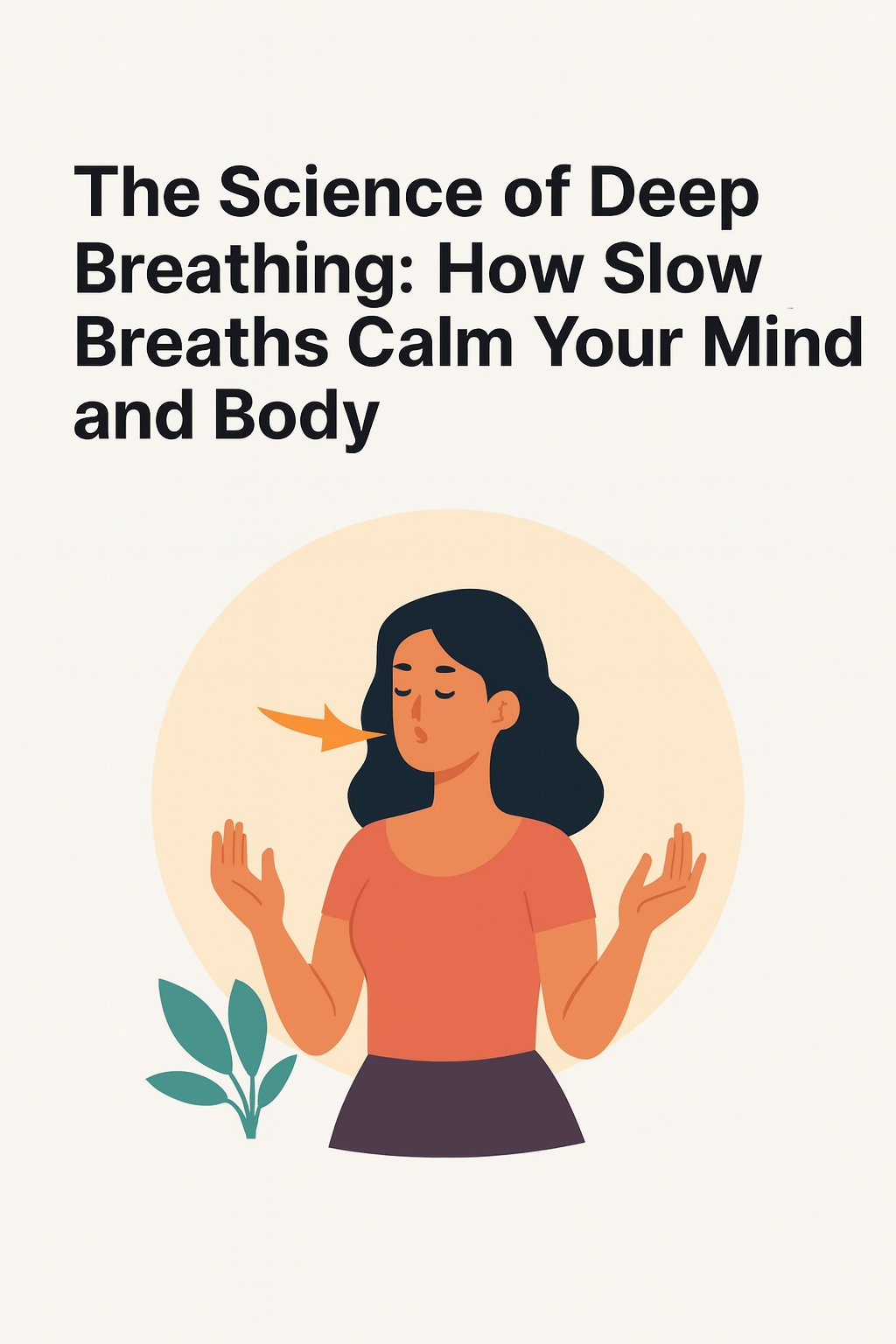
The Science of Deep Breathing: How Slow Breaths Calm Your Mind and Body
Meta Description
Learn how deep breathing activates your vagus nerve, lowers stress hormones, and improves focus — backed by modern neuroscience.
🧠 Why Deep Breathing Works
Breathing is the only automatic process we can consciously control — and that’s powerful.
When you slow your breath, you send a signal to your autonomic nervous system to switch from “fight-or-flight” mode to “rest-and-digest.”
According to a 2023 Harvard Health review, practicing slow breathing for 5 minutes reduces cortisol levels by up to 25%, promoting calmness and clear thinking.
This process activates the vagus nerve, which connects the brain to key organs like the heart and gut.
💓 The Physiology Behind Calmness
When stress hits, your sympathetic nervous system increases heart rate and blood pressure.
Slow, steady breathing does the opposite — it activates the parasympathetic system, restoring equilibrium.
A study in Frontiers in Human Neuroscience (2022) found that people who practiced 6 breaths per minute experienced:
- A 15% reduction in heart rate,
- Improved oxygen delivery,
- And higher alpha brain wave activity, associated with relaxation and creativity.
🌿 Practical Techniques for Beginners
You don’t need special tools — just patience and consistency.
1️⃣ Box Breathing (4-4-4-4)
Inhale for 4 seconds → hold for 4 → exhale for 4 → hold for 4.
Used by Navy SEALs to stay calm under pressure.
2️⃣ 4-7-8 Method
Inhale 4 seconds → hold 7 → exhale 8.
Created by Dr. Andrew Weil (Harvard), it enhances sleep quality and reduces anxiety.
3️⃣ Resonant Breathing
Maintain 5–6 breaths per minute.
Best for balancing blood pressure and focus during work.
| Technique | Best Time to Practice | Benefit |
|---|---|---|
| Box Breathing | Before meetings or exams | Calm focus |
| 4-7-8 Method | Before bed | Improved sleep |
| Resonant Breathing | Anytime | Stress balance |
🌙 The Mind-Body Connection
Breath is the bridge between the physical and emotional self.
In moments of anxiety, short shallow breaths reinforce tension.
But when you control your breathing, you regain control over your state of mind.
Neuroscientist Dr. Jack Feldman (UCLA, 2022) notes that slow exhalations stimulate the pre-Bötzinger complex, a brain region that signals the body it’s safe — naturally quieting fear circuits.
✅ Key Takeaway
Deep breathing isn’t just a mindfulness trend — it’s a biological reset button.
A few minutes a day can rewire your stress response, balance emotions, and boost mental clarity.
FAQ
Q: How often should I practice deep breathing?
A: Just 5–10 minutes daily is enough to see measurable changes in mood and focus.
Q: Can I combine breathing with meditation or yoga?
A: Yes. Combining both amplifies relaxation and improves heart rate variability (HRV).