Why Small Habits Improve Long-Term Health More Than Extreme Resets (Behavioral Science Explained)
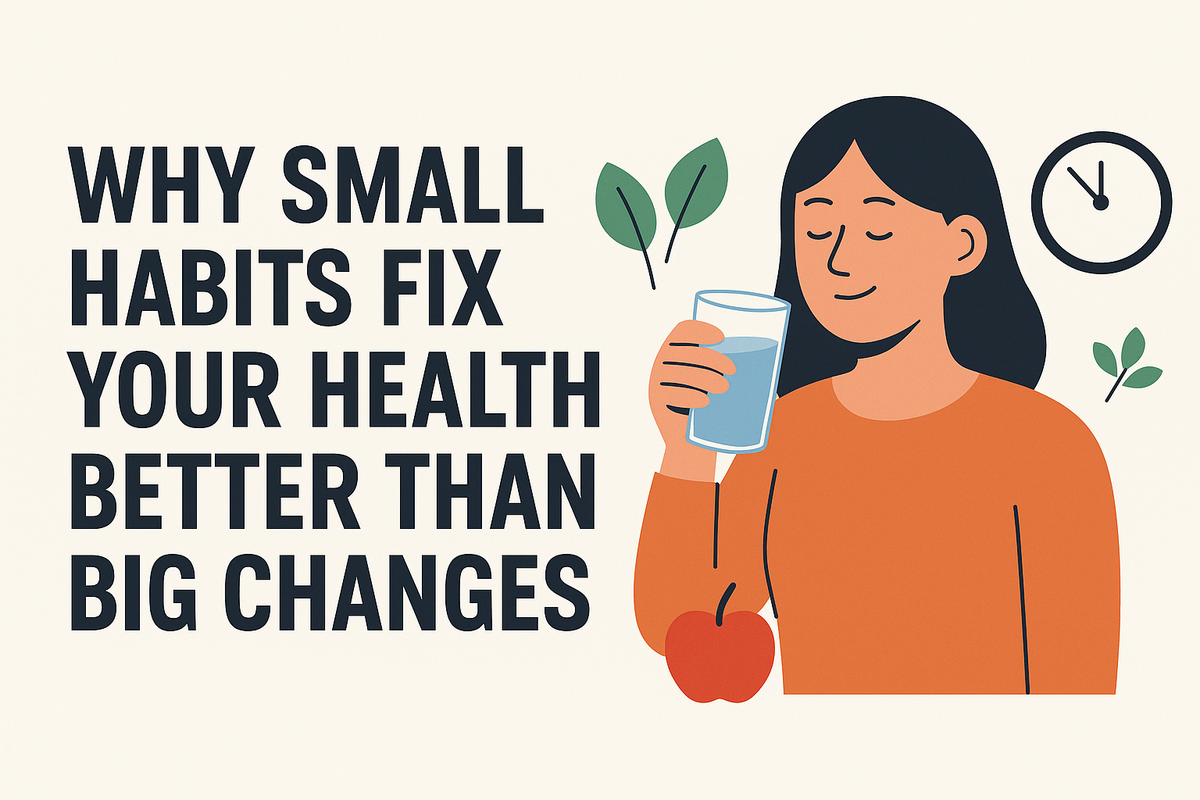
If you’ve ever tried to completely “reset” your health — a strict diet, an intense workout plan, a sudden productivity overhaul — you’ve likely experienced the same pattern.
Strong start.
Short spike in motivation.
Gradual collapse.
The problem isn’t discipline.
It’s neurobiology.
Most large lifestyle overhauls fail because they exceed the brain’s tolerance for cognitive and metabolic stress. Behavioral sustainability is determined less by willpower and more by neural load, reward prediction, and physiological adaptation.
This is where small habits outperform dramatic changes.
Not because they are trendy.
But because they align with how the nervous system encodes behavior.
The Biology of Habit Formation
Habits are encoded in the basal ganglia — a brain structure responsible for automation and pattern recognition.
When a behavior is repeated with minimal friction and consistent context cues, the brain reduces decision cost. Over time, the action becomes metabolically cheap.
Large changes do the opposite.
They increase:
- Cognitive demand
- Emotional resistance
- Cortisol release
- Perceived threat
The nervous system interprets extreme change as instability.
And unstable systems revert.
Small habits reduce this threat response.
The Metabolic Angle Most Articles Ignore
Large dietary shifts often disrupt glucose regulation temporarily.
For example:
- Sudden caloric restriction increases stress hormones
- Extreme carb removal can elevate cortisol
- Aggressive fasting may impair adherence
Small, incremental shifts — such as reducing processed food gradually or increasing daily movement by 10–15 minutes — maintain metabolic equilibrium.
Metabolic stability predicts long-term compliance.
Compliance predicts outcome.
Why Motivation Is the Wrong Target
Motivation is volatile.
Habit loops are stable.
Behavioral science shows that habit stacking — attaching a new behavior to an existing routine — dramatically increases adherence.
Example:
Instead of: “I will start exercising 60 minutes daily.”
Shift to: “After brushing my teeth, I will do 5 minutes of mobility.”
That shift reduces:
- Activation energy
- Emotional resistance
- Failure risk
Small behaviors compound.
Large resolutions collapse.
The Compounding Effect
Small daily improvements create nonlinear outcomes over time.
A 1% daily improvement in sleep consistency, diet quality, or movement can meaningfully shift metabolic markers across months.
The key variables affected include:
- Insulin sensitivity
- Inflammatory load
- Resting heart rate
- Sleep depth
None of these respond well to short-term intensity bursts.
They respond to sustained rhythm.
Why Big Changes Feel Powerful (But Rarely Last)
Extreme changes create dopamine spikes.
Dopamine is not pleasure.
It is anticipation.
When novelty fades, the behavior loses reward value.
Small habits avoid the dopamine crash cycle because they are not novelty-driven.
They are repetition-driven.
Repetition builds identity.
Identity stabilizes behavior.
The Psychological Safety Factor
The brain prioritizes predictability.
Small adjustments preserve environmental familiarity.
Radical shifts trigger subconscious threat detection.
This is why extreme diet or productivity plans often increase anxiety.
Low-anxiety change sustains longer.
Who Benefits Most From Micro-Adjustments
Small-habit frameworks are particularly effective for:
- Individuals with high stress load
- People recovering from burnout
- Those with metabolic instability
- Individuals with history of yo-yo dieting
For already disciplined individuals, dramatic shifts may be tolerated temporarily.
But for most people, sustainability predicts health more than intensity.
What This Means Practically
Instead of:
- Eliminating entire food groups
- Committing to unrealistic gym frequency
- Cutting sleep to wake earlier
Focus on:
- One dietary upgrade
- One movement anchor
- One sleep improvement
Layer slowly.
Let the nervous system adapt.
Then expand.
The Real Outcome
Health is not transformed by heroic effort.
It is stabilized by low-friction repetition.
Small habits reduce:
- Cortisol volatility
- Behavioral fatigue
- Identity conflict
Over time, they alter baseline physiology.
That is what long-term health actually is:
Baseline shift.
Not dramatic restart.