Why Your Lashes Are Thinning — And What Science Says About Growing Them Back
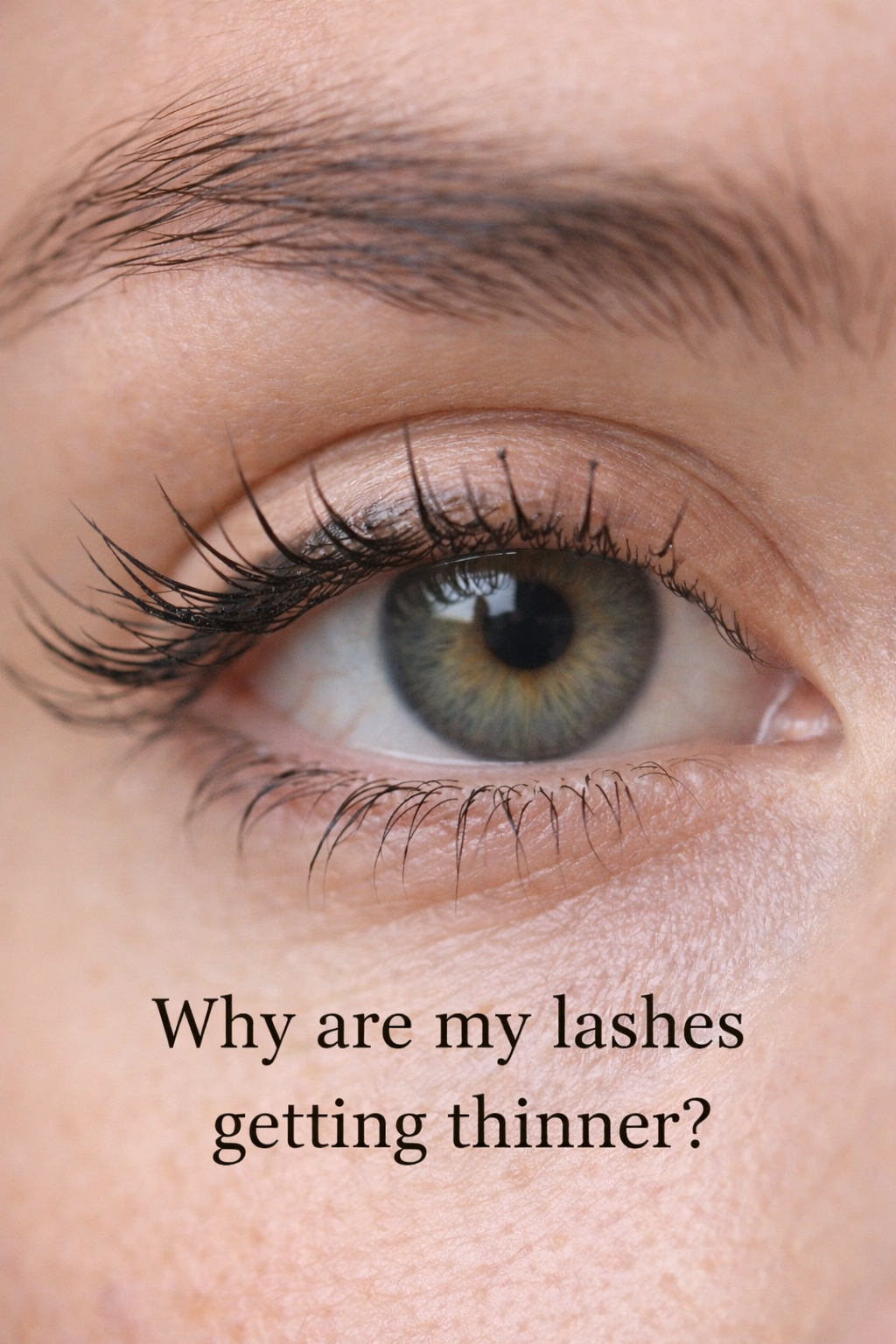
Most people don’t notice lash thinning until something small changes.
Mascara stops building volume the way it once did. The outer corners look uneven. Curl doesn’t hold. Extensions, once removed, reveal less density than expected.
It feels cosmetic.
But it isn’t.
Eyelashes are hair. And like all hair, they follow biology.
Understanding that biology — rather than reacting with more product, more friction, or more cosmetic layering — is the first step toward restoring what was lost.
The Lash Growth Cycle No One Explains Properly
Each eyelash moves through three distinct phases:
Anagen (growth phase)
This is when the follicle actively produces a new lash. Unlike scalp hair, lash anagen is short — typically 4 to 10 weeks. That means growth potential is biologically limited.
Catagen (transition phase)
The follicle detaches from its blood supply and prepares to rest.
Telogen (resting phase)
The lash eventually sheds and the cycle restarts.
At any given time, only about 40% of upper lashes are in active growth.
This matters.
Because when people experience thinning, it’s often not that lashes “aren’t growing.” It’s that fewer follicles are in anagen — or lashes are breaking before completing the cycle.
The solution, therefore, isn’t aggressive stimulation.
It’s follicle support and cycle protection.
Why Lashes Thin in the First Place
Lash thinning is rarely genetic alone. More often, it’s cumulative stress.
Here are the most common contributing factors.
1. Mechanical Stress
Curlers used daily. Waterproof mascara removed with friction. Extensions adhered repeatedly.
Each of these can weaken the lash shaft and irritate the follicle.
Even subtle tension over time can push follicles prematurely into telogen.
2. Inflammation of the Lash Line
Blepharitis (low-grade eyelid inflammation) is more common than people realize. Chronic irritation reduces the stability of the follicular environment.
When inflammation is present, growth shortens.
3. Hormonal Shifts
Just as scalp hair responds to hormonal fluctuation, lashes do as well. Thyroid imbalance, postpartum hormone changes, or stress-related cortisol spikes can influence density.
4. Nutritional Gaps
Protein intake, iron levels, and certain micronutrients influence keratin production. While deficiencies severe enough to cause lash loss are uncommon, marginal nutritional stress can affect cycle timing.
5. Aging
With age, anagen shortens. Follicles miniaturize. Density declines gradually.
This is biology, not failure.
What Actually Supports Lash Regrowth
Marketing often suggests “growth acceleration.”
But the body does not work like a speed dial.
The science suggests three practical targets instead:
- Protect existing lashes
- Reduce follicle inflammation
- Support the anagen phase
Let’s break that down.
Protecting the Existing Lash
The easiest gain is preventing breakage.
Avoid excessive curling pressure. Replace waterproof formulas with gentler options when possible. Remove makeup with oil-based cleansers that dissolve product instead of requiring friction.
Small mechanical changes often produce visible improvement within one cycle (6–8 weeks).
Reducing Follicular Stress
Clean lash margins gently. Avoid heavy occlusive products near the lash base. If irritation persists, evaluation for blepharitis or dermatitis may be helpful.
Inflammation shortens growth.
Calm follicles grow longer.
Supporting the Growth Phase
This is where topical support can play a role.
While prescription prostaglandin analogs are clinically proven to extend anagen, many individuals prefer non-prescription approaches that focus on conditioning peptides, panthenol, and botanical extracts that create a healthier follicle environment.
A well-formulated eyelash enhancing serum does not override biology — but it can reduce breakage, improve lash flexibility, and support follicle stability over time.
The key word is consistency.
Growth cycles cannot be rushed. But they can be supported.
The Timeline Most People Misunderstand
Lashes do not respond in days.
If a follicle is currently in telogen, nothing applied today will force immediate growth tomorrow.
Most measurable improvements follow this pattern:
- Weeks 1–4: Reduced breakage, improved texture
- Weeks 4–8: Visible density stabilization
- Weeks 8–12: New growth becomes noticeable
Anything promising dramatic change in 7 days is misaligned with biology.
Patience is not optional. It is structural.
Common Mistakes That Slow Recovery
Over-applying product
More does not equal faster growth. Excess product increases irritation risk.
Switching routines every two weeks
Follicles need stability. Constant experimentation disrupts consistency.
Ignoring overall health
Sleep quality, protein intake, and stress regulation influence hair cycling globally.
Lashes are not isolated from systemic biology.
A Sustainable Routine for Thinning Lashes
A research-aligned approach looks like this:
Morning
- Gentle cleanse
- Minimal friction
- Mascara applied lightly, removed fully
Evening
- Thorough but gentle removal
- Light lid hygiene if needed
- Single application of a consistent lash growth serum along the upper lash line
No layering.
No aggressive brushing.
No doubling doses.
Routine stability often produces more change than product intensity.
When to Consider Medical Evaluation
While most thinning is mechanical or age-related, certain signs warrant medical review:
- Sudden, patchy lash loss
- Associated scalp shedding
- Eyebrow thinning
- Persistent redness or itching
Conditions such as alopecia areata or thyroid imbalance can present with lash changes.
If thinning is rapid or accompanied by other symptoms, evaluation is appropriate.
The Psychological Layer No One Talks About
Lashes frame the eyes. They affect perceived alertness and symmetry. When density declines, it subtly shifts facial balance.
People often respond by adding more cosmetic intensity — heavier liner, thicker mascara, more extensions.
But these solutions can amplify the underlying issue.
Restoration requires stepping back.
Less friction.
Less manipulation.
More patience.
The Biology of Expectation
Hair biology operates on cycle logic, not consumer timelines.
Every lash that sheds is part of renewal.
The goal is not permanent lengthening.
The goal is optimizing the cycle that already exists.
That means:
- Supporting follicles
- Protecting growth phases
- Avoiding unnecessary trauma
- Allowing time
When approached this way, improvement feels gradual — but stable.
What Realistic Results Look Like
Not dramatic transformation.
Not artificial density.
Instead:
- Reduced corner sparseness
- Better curl retention
- Fewer broken tips
- More uniform growth patterns
Subtle changes compound.
Three cycles (roughly 3–4 months) often produce more meaningful results than a frantic 3-week overhaul.
Final Perspective
Lash thinning is common.
It is rarely catastrophic.
And it is almost always tied to cycle biology rather than permanent loss.
Understanding that removes urgency.
Once you respect the rhythm of the follicle, your strategy shifts from “fix immediately” to “support consistently.”
That shift alone changes outcomes.
Hair — even in miniature form on the eyelid — obeys the same scientific principles everywhere on the body.
Protect it.
Calm it.
Support it.
Wait for it.
The biology will do the rest.
If you'd like, next we can:
• Strengthen this for higher Google topical authority
• Add structured FAQ schema section
• Optimize headings for better SERP positioning
• Or create a matching non-product hero image for the article
We build this long-term, not fast.